World Cup 2026 will be one of the biggest global moments for football fans, and brands will compete heavily for attention during the season.
But during a major event like the World Cup, almost every brand will post football-themed visuals, giveaways, match predictions and celebration content.
So the real question is:
How can your World Cup campaign stand out?
One powerful way is through Augmented Reality campaigns.
With AR, brands can turn passive audiences into active participants. Instead of only seeing your campaign, people can try it, play it, share it, visit your store and redeem rewards.
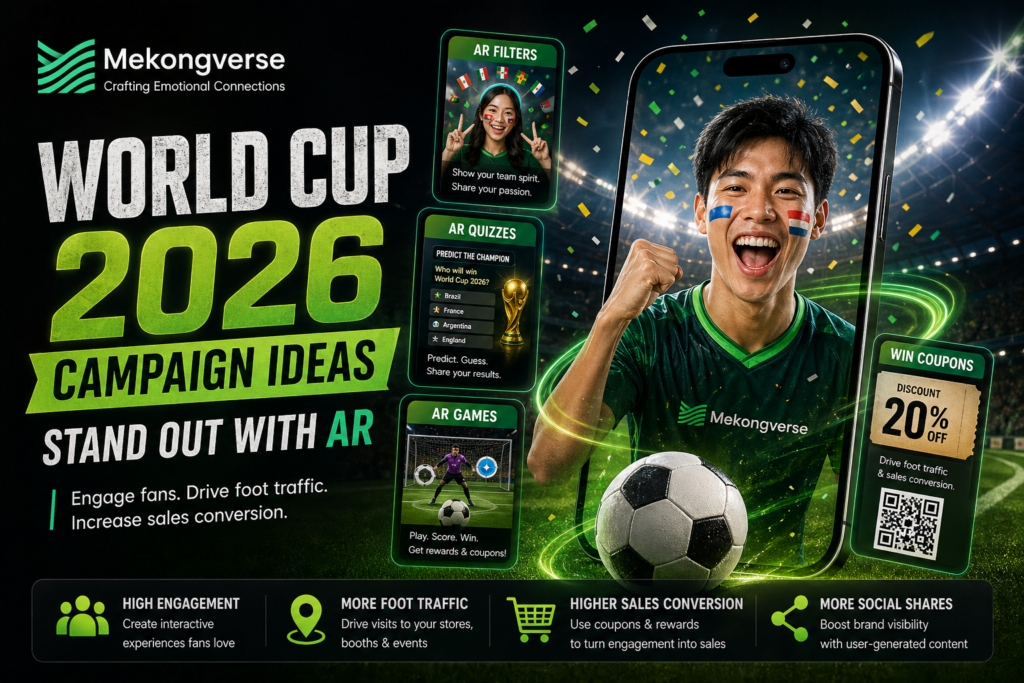
For World Cup 2026, Mekongverse classifies AR campaign ideas into three main content types:
- AR Filters
- Interactive AR Quizzes
- AR Games
These experiences can be used for both online campaigns through TikTok AR or WebAR, and brand activations through AR Mirror or AR Booth.
The goal is simple: make your campaign more interactive, more memorable and more connected to real business results.
Why World Cup 2026 Is a Big Opportunity for Brands
The World Cup is not just a sports event. It is a cultural moment.
People cheer for their favorite teams, predict match results, watch games with friends, post reactions, join conversations and celebrate wins together.
For brands, this creates a powerful opportunity to be part of the excitement.
However, attention will be crowded. Many brands will use similar football visuals, social media posts and giveaways. To stand out, brands need something more interactive.
That is where AR becomes useful.
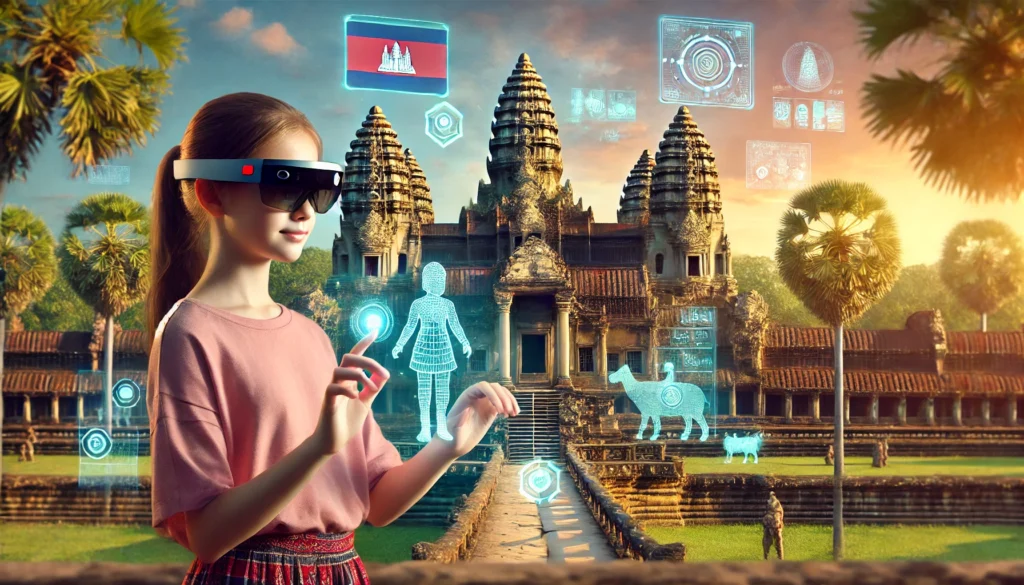
AR helps brands create experiences that people can actively join. A fan can wear a football face filter, answer a quiz, play a goal-scoring game, receive a coupon and visit a store or booth to redeem a reward.
Instead of saying “Look at our campaign,” AR says:
Come and play with our brand.
1. AR Filters: Turn Football Fans into Brand Ambassadors
AR Filters are one of the easiest ways for brands to join the World Cup conversation.
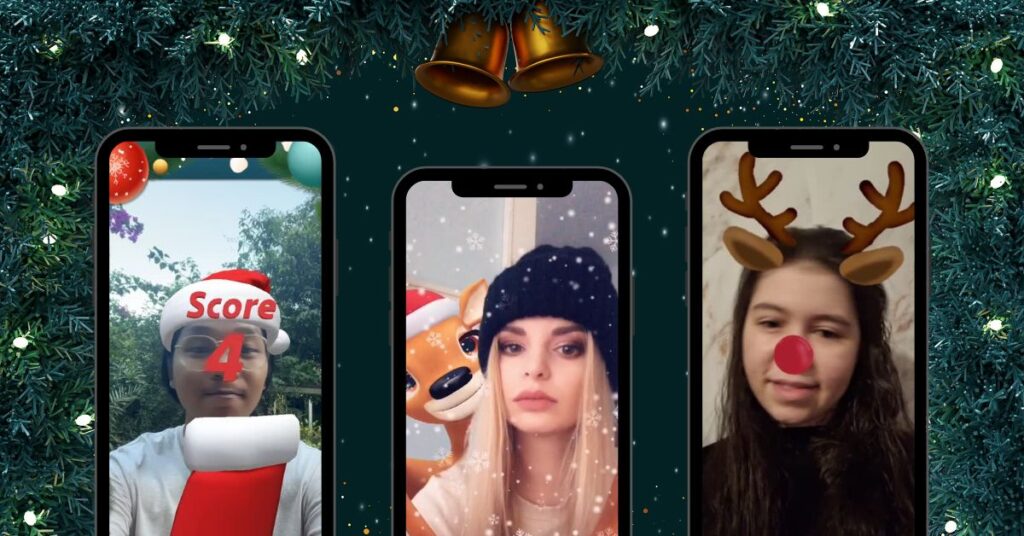
Fans already love showing support for their favorite teams. With AR Filters, brands can let users add football face paint, team colors, flags, stadium backgrounds, celebration effects or branded football frames to their photos and videos.
This makes the campaign feel personal, fun and easy to share.
For example, a brand can launch a Support Your Team Filter where users wear virtual face paint and show their favorite team spirit. This can be used as part of a hashtag challenge or photo contest.
Another idea is a Celebration Filter that appears after big matches. Users can celebrate a team win with confetti, fireworks, trophies, stadium lights and branded effects.
Brands can also create a Hero Photobooth Filter, where users take photos or videos with a football idol-inspired character, mascot or branded football avatar. This gives fans a fun “football hero” moment that they can download and share.
AR Filters work well because they make users become part of the campaign. Every shared photo or video becomes a small piece of brand media created by the audience.
For World Cup campaigns, AR Filters are useful for:
- Awareness
- User-generated content
- Social sharing
- Hashtag challenges
- Match-day celebration content
- Brand visibility
This type of AR content is especially strong when the campaign goal is to reach more people and create social buzz.
2. Interactive AR Quiz: Make Fans Predict, Guess and Share
Football fans love predictions and challenges.
Who will win tonight?
Which team will become champion?
Which player are you?
How much do you know about football?
Interactive AR Quizzes help brands turn these simple questions into fun, shareable campaign experiences.
Instead of posting a normal quiz on social media, brands can make the quiz feel more playful through AR. Users can answer questions, receive a result and share it with friends.
One simple idea is a Predict the Champion Quiz. Users answer a few questions and receive a predicted champion team result. The result can appear as a branded share card or short video.
Another idea is a Match Result Randomizer, where users open the AR experience and receive a random match prediction, such as the winning team or final score. This works well before match days because people enjoy sharing predictions and comparing results with friends.
Brands can also create a Guess the Player Quiz, where users answer football trivia questions or guess players, countries, flags or team facts.
For a more fun and emotional direction, brands can create a What Type of Football Fan Are You? quiz. Users answer personality-style questions and receive results such as “The Loud Supporter,” “The Tactical Analyst,” “The Lucky Fan,” or “The Final-Minute Believer.”
Interactive AR Quizzes can also support product campaigns. For example, a snack brand can create a “Your Perfect Match-Day Snack” quiz, while a café can create a “Which Football Drink Combo Are You?” quiz.
This type of AR content is useful because it gives users a result they want to share. It can also help brands collect leads, distribute rewards or guide users toward products.
Interactive AR Quizzes are useful for:
- Engagement
- Pre-match hype
- Social sharing
- Lead generation
- Data collection
- Product recommendation
- Brand education
For brands that want more than awareness, AR Quizzes can connect fun participation with campaign data and customer actions.
3. AR Games: Turn World Cup Excitement into Playable Brand Experiences
AR Games are one of the strongest campaign formats for deeper engagement and conversion.
Instead of only asking audiences to watch, like or comment, AR Games invite them to physically interact with the brand.
Users can move their head, blink, raise their hands, kick virtually, score goals, save shots or collect branded items.
For World Cup 2026, AR Games can turn football excitement into a playable campaign experience.
A brand can create a Goal Scoring AR Game, where users try to score as many goals as possible within a time limit. The final score can be connected with rewards, such as coupon discounts or lucky draw entries.
Another idea is a Goal Saving AR Game, where users become the goalkeeper and move their body to save penalty shots. This works well for events and mall activations because it creates a fun crowd moment.
Brands can also create a Football Runner AR Game, where users control a football player through head movement or blinking. They can avoid obstacles, collect football items and pick up branded rewards inside the game.
A simpler idea is a Header Challenge, where users use face or head movement to hit footballs and score points.
The strongest sales-focused format is a Score and Win Game. Users play a branded football AR game, submit their score and unlock a coupon, discount code, instant reward or QR voucher.
This can be turned into a Play and Redeem Campaign, where users complete the AR game and receive a coupon that can be redeemed at a store, booth, restaurant, café or retail outlet.
This is where AR Games become more than engagement. They can help drive foot traffic, product trials and sales conversion.
AR Games are useful for:
- Sales promotions
- Coupon discount campaigns
- Instant win campaigns
- Product trial campaigns
- Store visit campaigns
- Foot traffic generation
- Event engagement
- Mall activations
- Brand booths
- Product launches
- Retail conversion campaigns
For World Cup 2026, this makes AR Games a strong choice for brands that want people to do more than watch. They can play, win, visit and buy.
How Brands Can Use These AR Experiences
These AR content types can be used across two main campaign formats:
Online Campaign with TikTok AR or WebAR
This is best for reaching people through mobile and social media. Users can access the experience through a TikTok AR filter, WebAR link, QR code, influencer post, social media ad or brand microsite.
TikTok AR is strong for viral reach, UGC, short-form video sharing, hashtag challenges and fan participation.
WebAR is strong for custom campaign flows, lead generation, score submission, coupon distribution and reward redemption. Users can join the experience directly through a link without downloading an app.
For example, a beverage brand can launch a WebAR football game. Users play the game, score points and unlock a QR coupon for a discount. To redeem the coupon, they visit the nearest store or participating outlet.
Brand Activation with AR Mirror or AR Booth
This is best for physical locations such as shopping malls, retail stores, restaurants, cafés, fan zones, product launches, public viewing events and entertainment venue
With AR Mirror or AR Booth, users stand in front of a large screen and see themselves inside a branded football AR experience. They can take photos, answer quizzes or play games using body movement, hand gestures or face tracking.
For example, a shopping mall can set up a World Cup AR Game Booth. Visitors play a penalty challenge on the AR Mirror. Players who reach a target score receive a QR voucher that can be redeemed at selected stores in the mall.
This helps brands attract attention, increase dwell time, encourage store visits and create shareable moments.
Example Full Campaign Journey
The strongest World Cup campaign can combine online and offline AR.
A brand can first launch an online AR experience to build awareness, then connect it with a physical activation that drives foot traffic and sales.
Here is one possible journey:
Step 1: Online Awareness
Launch a TikTok AR Filter where users show support for their favorite team.
Step 2: Online Engagement
Launch a WebAR quiz or football game where users predict the champion or play to win points.
Step 3: Reward Mechanic
After completing the AR experience, users unlock a coupon discount, instant reward or QR voucher.
Step 4: Offline Visit
Users visit the store, mall booth, café, restaurant or event venue to redeem the reward.
Step 5: On-Ground Experience
At the location, users can also play an AR Mirror football game or take a branded AR photo.
Step 6: Share and Convert
Users download their photo or video, share the experience online and complete a purchase or redemption.
This creates a full campaign journey:
See → Play → Win → Visit → Redeem → Buy → Share
Choosing the Right AR Type for Your Campaign
Different campaign goals need different AR content.
If your goal is awareness, AR Filters are a good starting point because they are simple, shareable and easy for users to join.
If your goal is engagement or data collection, Interactive AR Quizzes work well because users can answer questions, receive results and submit information.
If your goal is foot traffic or sales conversion, AR Games are the strongest option because they can connect scoring, rewards, coupons and redemption.
For many brands, the best approach is to combine all three.
An AR Filter can create awareness.
An AR Quiz can create engagement.
An AR Game can drive conversion.
Together, they create a complete World Cup campaign experience.
Why Brands Should Use AR for World Cup 2026
World Cup campaigns are highly competitive. Many brands will use football images, captions, giveaways and promotions.
AR helps brands stand out because it creates participation.
People do not just look at the campaign.
They become part of it.
They can wear the filter.
They can answer the quiz.
They can play the game.
They can get a score.
They can unlock a coupon.
They can visit the booth.
They can redeem rewards.
They can make a purchase.
They can share the experience.
That makes the campaign more memorable and more connected to real business results.
For marketers, AR can support multiple objectives:
- Awareness
- Engagement
- UGC
- Lead generation
- Foot traffic
- Coupon redemption
- Product trial
- Sales conversion
Final Thoughts
World Cup 2026 is a major opportunity for brands in Cambodia and across Southeast Asia.
But to stand out, brands need more than football-themed posters and basic giveaways.
AR Filters, Interactive AR Quizzes and AR Games can help brands create campaigns that people actively engage with and share.
For online campaigns, brands can use TikTok AR or WebAR to reach users through mobile and social media.
For physical activations, brands can use AR Mirror or AR Booth to create memorable experiences at malls, stores, cafés, fan zones and events.
And when AR experiences are connected with coupon discounts, instant rewards and QR redemption, they can help drive real foot traffic and sales conversion.
At Mekongverse, we help brands create AR experiences for online campaigns, events, activations, retail spaces and entertainment venues.
Planning a World Cup 2026 campaign?
Let’s create an AR experience your audience will play, share and remember. Don’t forget to discuss with us.