Launching a new product in Cambodia is not just about announcing it. It is about creating enough excitement that people notice it, talk about it, share it, and remember it.
That matters even more today because Cambodia is a highly connected, mobile-first market. As of early 2025, the country had 10.8 million internet users, and social media user identities were equivalent to 72.4 percent of the population. That means your audience is already online, already scrolling, and already deciding what deserves their attention.
So if your product launch only relies on a static booth, a press post, or a few event photos, it may be seen, but it will not necessarily make noise.
At Mekongverse, we believe the brands that stand out during launch moments are the ones that turn attention into interaction.
First, understand what “making noise” really means
A lot of brands think making noise means being loud. Bigger screens. More posters. More standees. More promoters.
But in reality, making noise during a product launch means creating momentum.
It means:
- People stop and notice
- People try the experience
- People capture content
- People share it on social media
- People tell their friends
- People remember the brand after the event
In other words, strong product launches create both physical presence and digital ripple effect.
This is not a new pattern in Cambodia either. Brand launches in the market have already combined big visibility formats with digital and social activation to cut through crowded categories. For example, Vattanac Brewery’s Krud launch used billboards together with digital and social activations during its market rollout.
Why product launches in Cambodia need more than visibility
Cambodia is a market where people respond strongly to experiences they can see, try, and share. With a large social media population and growing digital participation, launch campaigns have a much better chance of spreading when they give audiences something to do, not just something to look at.
That is why traditional product launch formats often struggle.
A beautiful stage setup may impress people at the venue. A nice product display may help the brand look premium. But if the audience has no reason to engage, the launch often ends there.
No replay value. No sharing behavior. No extra buzz.
If your goal is to create noise, the launch has to become participatory.
Turn your launch into something people can play with
One of the fastest ways to generate energy during a launch is to make the product experience interactive.
This is where experiential technology becomes powerful.
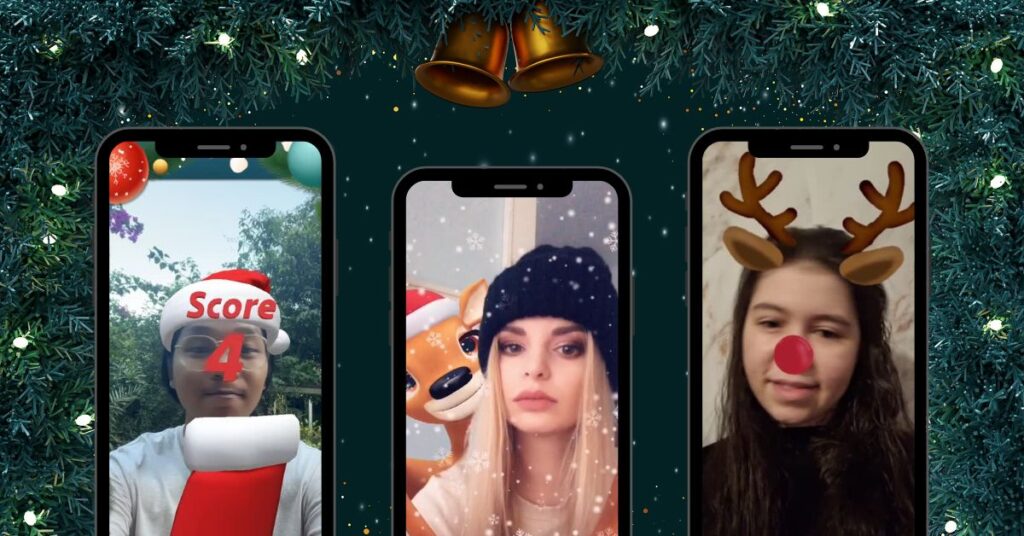
Instead of asking people to just look at the product, you invite them to engage with it through an AR game, AR mirror, WebAR interaction, or branded digital moment.
For example:
- A beauty brand launch can include an AR mirror try-on or personality-based experience
- A beverage launch can include a fast, fun AR game with prizes or instant-win rewards
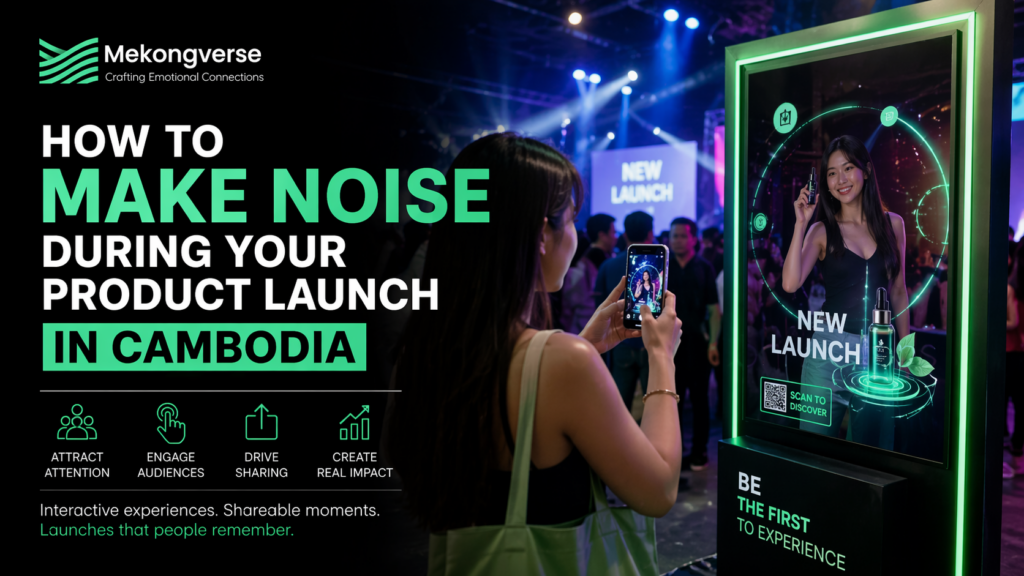
- A telecom launch can include a futuristic AR photobooth that makes people feel part of the brand story
- A retail launch can use WebAR to let people scan, unlock, and explore the product on their phones
These experiences do more than entertain. They help the product launch feel alive.
Design for shareability, not just attendance
A product launch should not only work for the people who are physically there. It should also create content that travels beyond the venue.
This is one of the biggest missed opportunities in launch planning.
If people are enjoying your launch but nobody is posting about it, your campaign is losing reach.
That is why launch experiences should be built with shareability in mind:
- Photo-worthy visual moments
- Branded AR effects
- Instant photo or video capture
- QR code download flow
- Social sharing prompt
- Giveaway or reward mechanics tied to participation
When people can leave the launch with a branded photo, short video, or fun result they want to post, your event starts generating its own media.
That is when noise begins.
Connect the offline launch with digital behavior
In Cambodia, the strongest launches are often not purely offline or purely digital. They work because they connect both.
Your launch event creates the first spark.
Your digital layer helps that spark spread.
That digital layer can include:
- WebAR experiences accessed by QR code
- Short-form content opportunities for TikTok or Facebook
- Social contest mechanics
- Instant coupon or reward redemption
- Microsite traffic after the event
- Lead capture or sign-up flow connected to the experience
This matters because social and internet usage in Cambodia is already significant, so the opportunity is not just to gather a crowd at launch, but to turn that crowd into online amplification.
Give people a simple reason to participate
One mistake brands make is building an experience that looks exciting but gives the audience no clear motivation.
Participation needs a trigger.
That trigger can be:
- Win a prize
- Unlock a discount
- Get a personalized result
- Capture a branded photo
- Join a challenge
- Access exclusive launch content
- Be one of the first to try something new
The simpler the value exchange, the better.
People do not want to figure out a complicated activation during a busy launch event. They want something fast, fun, and clear.
Try. Capture. Share. Reward.
That flow works.
Match the experience to the product category
Not every product launch needs the same type of noise.
A premium product may need elegance and wow factor.
A mass-market FMCG launch may need volume, fun, and sharing.
A mall or retail launch may need foot traffic and dwell time.
A youth-focused brand may need playful, camera-first interaction.
That is why the best launch activations are not random tech add-ons. They are designed around the brand, the product, and the audience.
For example:
- Premium launches may benefit from immersive branded AR mirror moments
- Youth campaigns may benefit from quick AR mini-games and UGC-friendly mechanics
- Retail launches may benefit from coupon-driven WebAR journeys
- Event-heavy launches may benefit from photobooths and crowd-pulling interactive screens
The goal is not to use technology for the sake of it.
The goal is to create the kind of launch noise your audience actually responds to.
Think beyond the launch day
A good launch gets attention for one day.
A smart launch creates assets and momentum that continue after the event.
That can include:
- User-generated content from the launch
- Short recap videos
- Branded photos shared by participants
- Retargeting audiences who scanned QR codes
- Follow-up offers
- Social posts showing how people interacted with the launch
When planned properly, your product launch becomes the starting point of a wider campaign, not a one-time event.
What brands in Cambodia should focus on now
If you want to make noise during your product launch in Cambodia, focus on these five things:
1. Make it interactive
Do not just show the product. Let people do something with it.
2. Make it camera-friendly
Build moments people naturally want to record and share.
3. Make it easy
The audience should understand the experience in seconds.
4. Make it reward-driven
Give people a reason to join immediately.
5. Make it extend online
Use QR, WebAR, social sharing, or digital follow-up so the launch lives beyond the venue.
How Mekongverse helps brands create launch noise
At Mekongverse, we help brands turn product launches into interactive experiences people want to try, capture, and share.
We do this through:
- AR Mirror experiences for launch events and activations
- WebAR experiences accessible on mobile
- AR games for product launch engagement
- AR photobooths for branded content creation
- Interactive reward and coupon mechanics
- Experience design that connects offline attention with digital sharing
Because in today’s Cambodia market, being present is not enough.
Your launch needs to move.
It needs to attract a crowd.
It needs to pull out phones.
It needs to create moments people talk about.
That is how brands make noise.
Final thought
If you are planning a product launch in Cambodia, do not ask only, “How do we announce this?”
Ask instead, “How do we make people feel part of it?”
That shift changes everything.
Because the launches that win are not always the loudest.
They are the ones people experience, remember, and share.