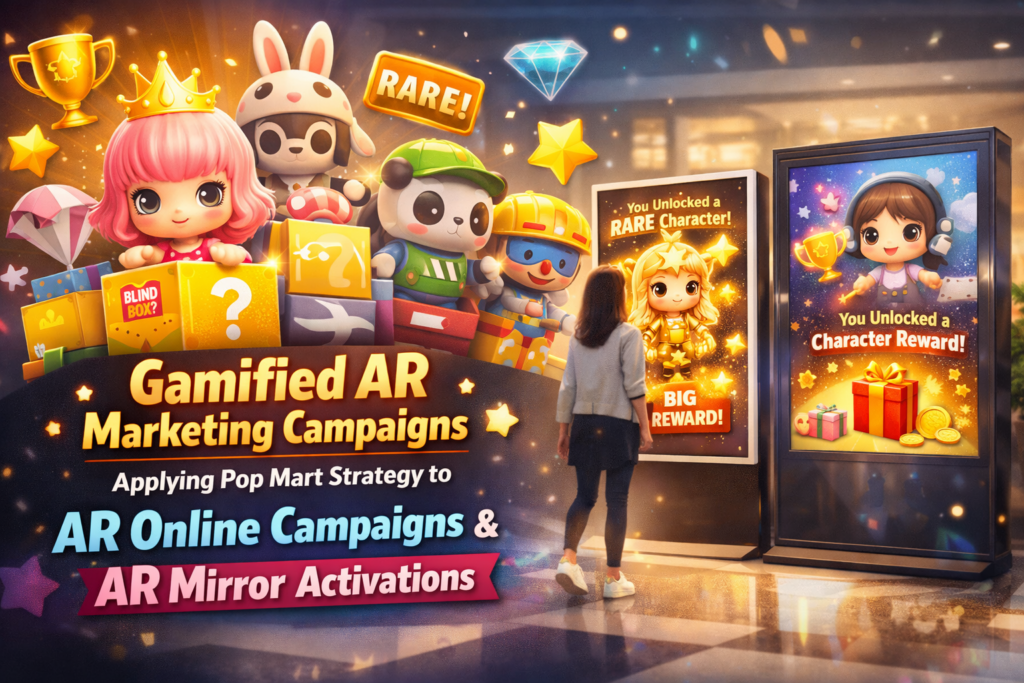
Pop Mart’s success is not just about designer toys. It is about gamification psychology built on surprise, rarity, and emotional reward. Blind boxes, rare characters, and the excitement of winning turn simple interactions into repeat behavior.
When these mechanics are applied to Augmented Reality, brands can transform AR filters and AR Mirror activations into playable marketing systems instead of one-off campaigns.
This blog explains the Pop Mart gamification concept, two AR customer journeys, and finally a clear guideline for brands to implement this strategy effectively.
Why Pop Mart Strategy Works for AR Campaigns
Pop Mart mirrors how successful games are designed:
- Uncertainty keeps people engaged
- Rarity increases perceived value
- Rewards create emotional highs
- Wins naturally trigger sharing
AR allows brands to apply these mechanics instantly, visually, and at scale.
The Core Gamification Concept Behind Pop Mart
Pop Mart’s strategy can be broken into five gamification pillars:
- Randomized rewards through blind-box mechanics
- Rarity tiers that control excitement and status
- Emotional reveal moments using animation and sound
- Reward differentiation between rare and general outcomes
- Social proof driven by share-worthy wins
These pillars form the foundation for all Pop Mart inspired AR campaigns.
Two AR Customer Journeys Using the Same Gamification Logic
Journey 1: Collection-Based AR Gamification
Best for online activation campaign using WebAR
Users unlock random characters, track progress, and complete collections to win premium rewards. Social sharing is required to move forward.
Journey 2: Instant Reward AR Mirror Gamification
Best for malls, stores, and offline activations using AR Mirror
Users get a random character instantly. Rare characters unlock big rewards, while general characters unlock standard rewards. No collection required.
Brand Implementation Guidelines: How to Apply Pop Mart Strategy in AR
This section provides practical, step-by-step guidance for brands planning to adopt the Pop Mart model using AR.
1. Create a Character System, Not Just One Mascot
Avoid using only a single character.
- Design multiple characters under one brand universe
- Or create different versions of one mascot (styles, outfits, moods, editions)
- Limit the total number to keep the system simple, usually 4 to 8 characters
Each character must feel collectible and visually distinct.
2. Define Rarity and Probability Early
Before building AR assets, define rarity logic:
- Common characters: 60–70% probability
- Rare characters: 20–30% probability
- Ultra-rare characters: 5–10% probability
This helps brands control budget, excitement, and reward distribution from day one.
3. Design Strong Reveal Moments
The reveal is the emotional core.
- Use short but dramatic animations
- Add sound effects or visual bursts
- Make rare reveals visually louder than general ones
A strong reveal makes even a simple reward feel special.
4. Match Rewards to Character Rarity
Reward value must always match rarity.
- Rare characters unlock big rewards such as premium vouchers, free products, or VIP access
- General characters unlock smaller but positive rewards like discounts, samples, or digital content
Everyone should win something, but not everyone should win the same thing.
5. Decide the Right Journey Type
Choose the journey based on campaign context:
- Use collection-based journeys for online, UGC, and longer campaigns
- Use instant reward journeys for activations and events
Brands can also combine both journeys under one campaign umbrella.
6. Build UGC into the Rules, Not the CTA
Do not ask users to share. Make sharing part of the system.
- Posting AR content can unlock rewards
- Social posting can be required for rare reward redemption
- Hashtags and tags become proof of participation
This turns users into voluntary promoters.
7. Control Cost with Digital Limits
AR allows full control without physical waste.
- Limit rare rewards per day
- Adjust probability dynamically
- Cap high-value prizes while keeping excitement high
This ensures scalability and budget safety.
8. Keep It Simple for Users
If users need explanation, the system is too complex.
- One action to start
- One reveal moment
- One clear outcome
Simplicity is critical, especially for offline AR Mirror experiences.
Why This Guideline Works for Brands
Following this framework helps brands:
- Design gamified AR campaigns systematically
- Avoid overcomplication
- Balance excitement and cost
- Scale campaigns across online and offline channels
Most importantly, it ensures the campaign feels fun, fair, and shareable.
Final Thoughts
Pop Mart proves that people love playing, collecting, and winning. AR gives brands the tools to apply this psychology without physical constraints.
By following these guidelines and embedding Pop Mart’s gamification principles into AR filters and AR Mirror activations, brands can move from passive exposure to active participation.
If your goal is to create AR campaigns people line up for, talk about, and share organically, this Pop Mart inspired approach is a proven and powerful starting point.