Product launches in Cambodia are changing.
What once worked—stage presentations, static displays, and long explanations—no longer holds attention. Audiences today are more exposed, more selective, and far more experience-driven.
The brands that stand out are not the ones that talk the most about their products. They are the ones that design how people experience them.
Whether your launch takes place as a private event at a hotel or a public activation in a shopping mall, the same question applies:
What will people remember after they leave?
The Shift: From Announcements to Experiences
In today’s landscape, a product launch is no longer just an announcement. It is a brand moment.
Consumers and VIP guests attend many events each year. What cuts through is not information, but interaction. Not features, but feeling. Not explanations, but participation.
This shift is especially relevant for brands launching products in Cambodia, where:
- Attention is fragmented
- Social sharing amplifies or kills momentum
- Physical spaces compete aggressively for engagement
Product launches must evolve from presentations into experiential touchpoints.
Two Product Launch Contexts, One Experience Mindset
Most product launches in Cambodia fall into two environments:
- Private launches at hotels
- Public launches at shopping malls
The audiences differ, but the mindset should not.
Both environments benefit from experiences that feel intuitive, memorable, and worth sharing.
Rethinking Private Product Launches at Hotels
Private launches often involve media, influencers, partners, and VIP stakeholders. Traditionally, these events rely heavily on controlled demos and guided explanations.
But VIP engagement today is not about being guided. It is about being invited in.
AR Mirror as a VIP Event Experience
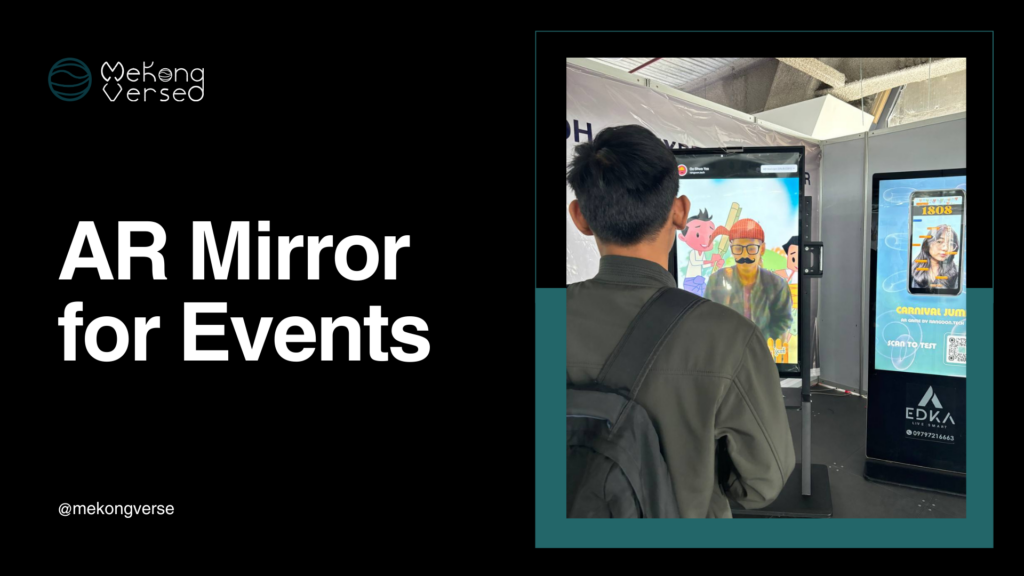
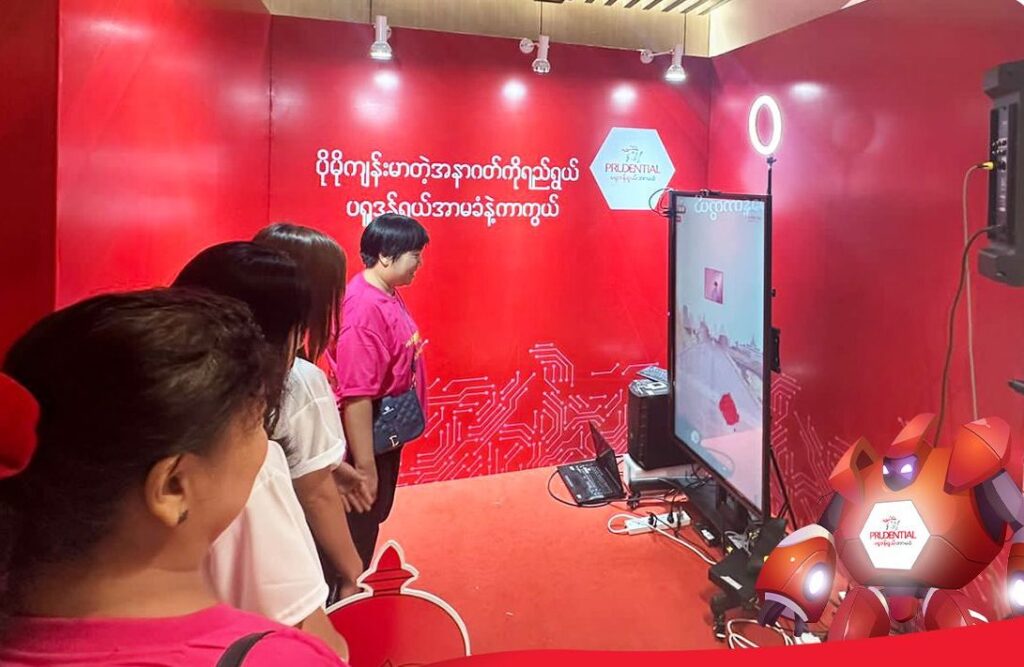
Instead of treating AR as a demo tool, brands are increasingly using AR Mirrors as part of the event atmosphere itself.
Placed in VIP lounges, networking areas, or cocktail zones, the AR Mirror becomes:
- A moment of discovery
- A branded experience guests choose to engage with
- A visual expression of innovation
Guests step in, see themselves inside a branded AR environment, interact naturally, and move on—no instruction required.
The experience respects the guest’s time, autonomy, and curiosity.
This is not about explaining technology.
It is about embodying the brand.
Public Product Launches at Shopping Malls: Experience Is the Only Advantage
Shopping malls offer scale, but they also expose a brand to distraction.
In public spaces, people do not stop because something is informative. They stop because something is engaging.
Static booths, screens, and banners compete poorly against interactive experiences.
Why Experience Wins in Mall Launches
A successful mall product launch:
- Captures attention in seconds
- Invites participation without instruction
- Feels playful, not promotional
- Turns visitors into content creators
This is where experiential technologies like AR Mirrors become powerful.
Case Study: How Samsung Used an AR Mirror Game to Transform a Mall Launch
Samsung’s new phone model launch at Shopping Mall demonstrates this shift clearly.
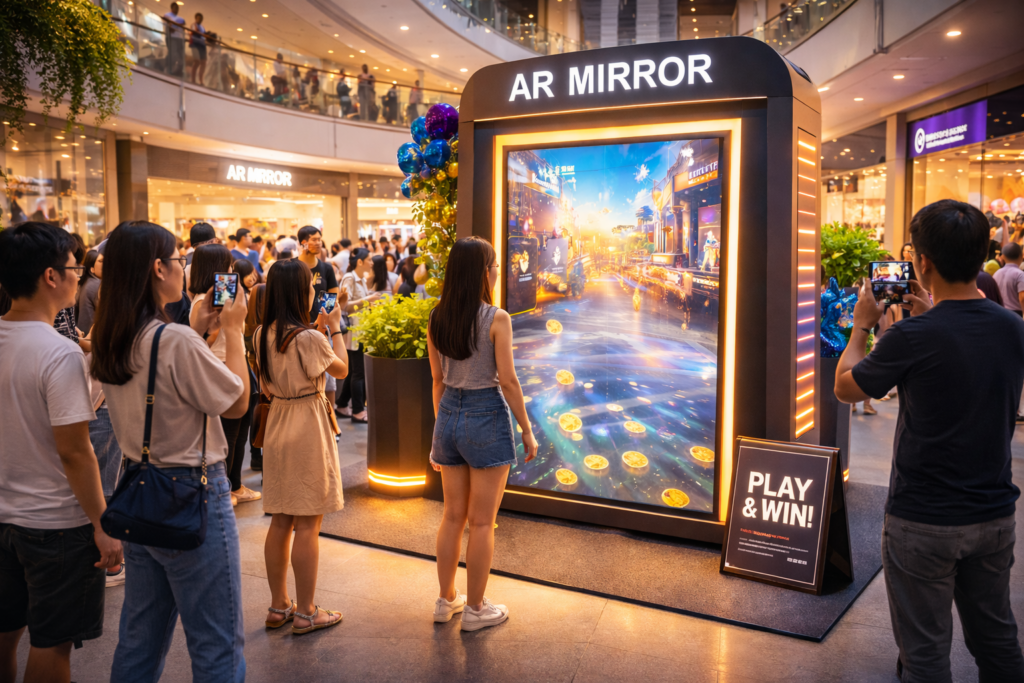
Rather than relying on static product displays, Samsung partnered with Mekongverse to create a custom AR Mirror Game as part of their public launch activation.
The idea was simple but effective:
- Visitors saw themselves on screen in real time
- Branded AR visuals responded to their movements
- A short, intuitive game invited participation without explanation
The result was not just engagement—it was involvement.
People didn’t just look at Samsung’s launch. They became part of it.
Why It Worked
- The experience required no learning curve
- Interaction felt natural and human
- The game format lowered barriers to entry
- Participants captured and shared their moments organically
Samsung didn’t ask for attention.
The experience earned it.
This is the difference between exposure and engagement.
One Principle That Defines Standout Product Launches
Across both private and public launches, one principle holds true:
People remember what they experience, not what they are told.
Experience-led launches:
- Create emotional connection
- Encourage voluntary participation
- Generate organic reach
- Elevate brand perception instantly
This is why experiential formats like AR Mirrors are no longer “nice to have.” They are becoming core launch infrastructure.
Where Many Product Launches Still Fall Short
Even strong brands often make the same mistakes:
- Over-explaining instead of engaging
- Treating technology as a feature, not an experience
- Designing events for control, not curiosity
- Underestimating the power of shareable moments
The result is a launch that looks good—but is quickly forgotten.
Final Thought: Product Launches Are Brand Statements
A product launch is not just about introducing something new. It is about signaling who you are as a brand.
In Cambodia’s evolving market, the brands that stand out are the ones that:
- Design experiences, not just events
- Invite participation, not attention
- Let people feel the brand before understanding it
As Samsung’s launch demonstrates, experience is no longer the layer on top.
It is the foundation.
At Mekongverse, we believe product launches should not just be seen — they should be experienced.